MORTL · MMXXVI
You're Going
to Die.
Let's Talk
About It.
Plain answers for overwhelmed people, state-specific law guides, and one checklist for before and after a death.
Overwhelmed or starting from zero? Start here. Get the next three tasks.
Someone just died? That path is free forever. No account required. Here's how we pay for it
We built MORTL because avoiding these conversations can leave people without information, instructions, or support when they need it.
Find Your Way In
Step 1 of up to 2
Where are you right now?
Choose the answer that’s closest. You can come back and choose a different path at any time.
More Than Reading
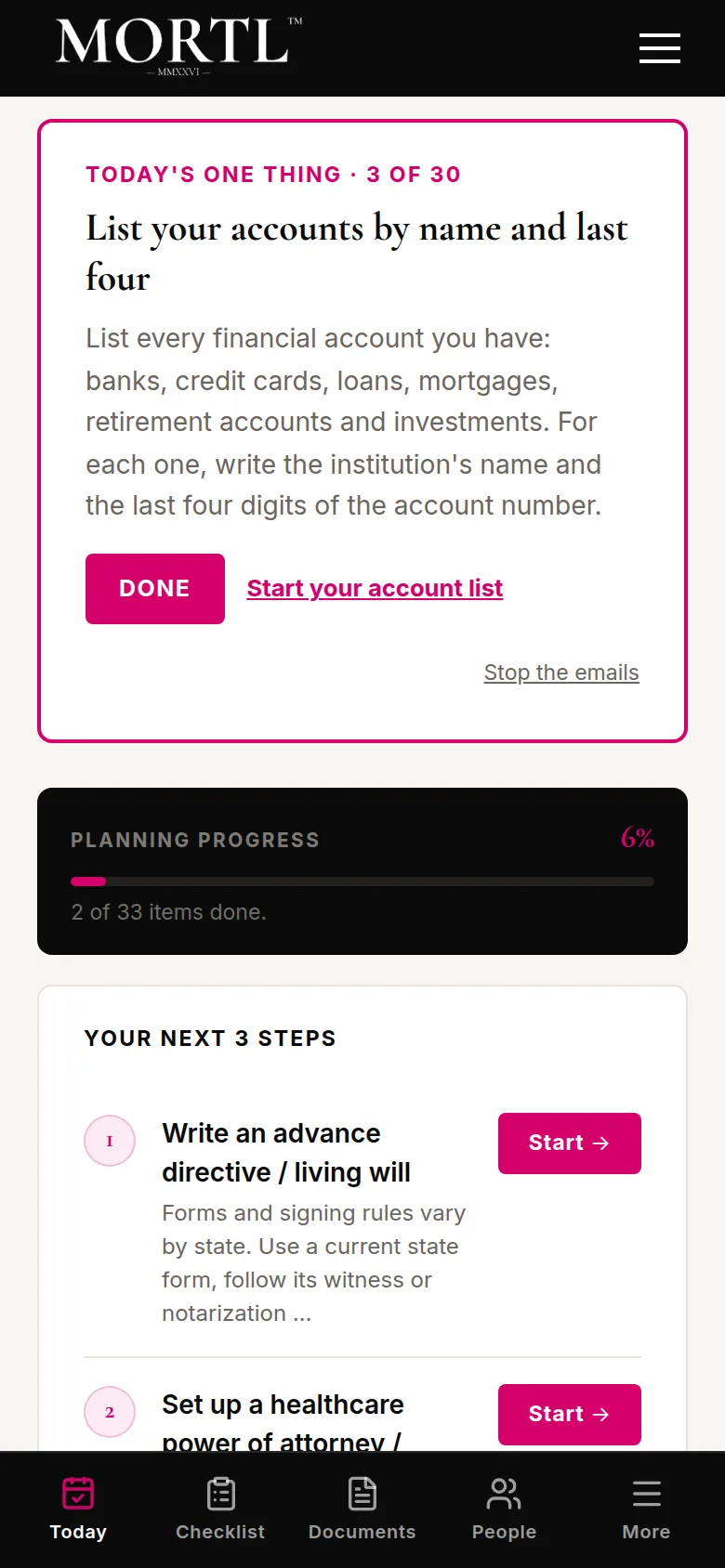
Put your plan somewhere your family can find it.

A checklist that knows your state.
Start without an account. Create a free account when you want to sync your checklist, documents, people, and wishes to a dashboard.
→Finish your plan. Then share it.
A Folder you can print for your family, 18 planning tools, family sharing, and an estate health check you can run whenever you want. $9 a month or $69 a year. The someone-just-died path stays free forever.
→Death, in your inbox, every Sunday.
One useful thing about death and planning each week, in plain words. Free. Unsubscribing is one click.
Free account
What a free account does.
- Keeps your checklist ticked on every device.
- One thing to do each morning, by email, if you want it.
- Your state's rules on the items that depend on them.
Free. The someone-just-died path never needs one.
What You Can Do on MORTL
The checklist, your state's rules, the providers, the answers.
End-of-Life Checklist
The complete list of what needs to happen before and after death. Printable, shareable, actually useful.
→State-by-State Guides
Death law varies wildly by state. We break it down for all 50 states plus Washington, DC. So you can understand the rules where you live.
→Provider Directory
Find funeral homes, grief counselors, and hospice providers near you. A listing in the MORTL directory isn’t a recommendation, endorsement, guarantee, or referral.
→The MORTL Edit
Practical reporting on probate, funeral costs, grief, digital accounts, and end-of-life care.
→Ask MORTL
Real questions about death, answered without the runaround.
→The Death Dispatch
Our weekly newsletter. One useful thing about death and planning, every Sunday.
→From the MORTL Edit
Practical reporting on death, money, and grief.
 End-of-Life Care
Hospice: What Nobody Tells You Until You're In It
Hospice is one of the most misunderstood parts of end-of-life care. Most families say they wished they'd started it sooner. Here's what it is, who qualifies, and what it covers.
Read → Culture
Grief in the Workplace: Bereavement Leave and Your Rights
Federal law doesn’t require paid funeral leave, employer policies vary, and a few states provide specific protections. Here’s what to check and how to ask for more time.
Read → Grief
GriefPet Memorial Ideas That Aren't a Poem
The collar on the shelf, the walk on their route, the donation with their name on it, and the four sentences only you can write. Pet memorial ideas that fit a real house and a real week, without a poem about a bridge.
Read →Quick Answers
The questions everyone has but nobody asks out loud.
What is MORTL?
MORTL is an independent publisher that helps people figure out what to do before and after a death. It gives adults plain-English answers, cited state-law guides, situation-based checklists, and planning tools, with optional saved features for handing a plan to family. MORTL isn’t a law firm, medical provider, funeral home, or financial institution.
What does MORTL cover?
MORTL covers the full spectrum of death-related topics: writing a will, probate law by state, advance directives and healthcare proxies, funeral and cremation planning, grief and bereavement, digital legacy and what happens to your accounts after death, estate taxes, organ donation, death with dignity laws, and talking to children about death. MORTL publishes state-specific legal guides for all 50 US states and Washington DC.
What is an advance directive?
An advance directive is a legal document that specifies your healthcare wishes if you become unable to communicate. It typically includes a living will (what treatments you want or don't want) and a healthcare proxy or durable power of attorney for healthcare (who can make decisions for you). Every US state has its own official advance directive form. MORTL provides links to the official form for 50 states and Washington DC.
What is probate and when is it required?
Probate is a court-supervised process for administering assets left in a deceased person's name, resolving valid claims, and making distributions. Whether court administration is required depends on state law, the assets involved, ownership, beneficiary designations, and available affidavit or simplified procedures. Assets properly held in a trust, survivorship property, and accounts with valid beneficiary designations commonly pass outside probate, subject to state rules.
How much does a funeral cost in the United States?
According to the National Funeral Directors Association (NFDA), the median cost of a funeral with viewing and burial in the United States is approximately $8,300 (2023 data). The median cost of a funeral with cremation is approximately $6,280. Costs vary significantly by region and funeral home. The FTC Funeral Rule requires funeral homes to provide itemized price lists upon request.
What happens to your digital accounts when you die?
What happens to your digital accounts after death depends on the platform and whether you’ve designated a legacy contact or digital executor. Facebook and Instagram allow memorialization or account removal. Google has an Inactive Account Manager. Apple has a Digital Legacy feature. Most states have adopted the Revised Uniform Fiduciary Access to Digital Assets Act (RUFADAA), which gives executors limited access to digital assets. Without planning, most accounts are inaccessible to family members.
Who's Behind This
One owner. Built from primary sources. Monitored every 30 days.
MORTL is owned and edited by Stephanie Werner, its CEO, founder, and editor. No investors, no parent company, no content farm. Every state guide is built from primary sources such as state statutes, court rules, and official government resources. Automated change monitoring runs every 30 days. Each state guide receives a source-level review at least annually and sooner when an official change or credible correction is identified. If we run sponsored content or a partnership, it's labeled on the page and doesn't change the guide’s editorial content.
Find Your Door